
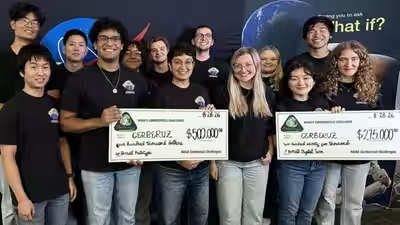
A student team named CERBERUZ from the Massachusetts Institute of Technology has won both tracks of NASA’s LunaRecycle Challenge, securing $925,000 in prize money for developing a system that turns lunar waste into useful materials. The initiative addresses the challenge of managing packaging, tools, and spare parts at future lunar bases without relying entirely on regular supplies launched from Earth.
The system processes non-biological lunar waste by splitting materials into plastics that melt when heated and everything else. All materials are ground into a fine powder and mixed together before being fed into an injection moulding machine, where melted plastics hold the pieces in place inside a mould. This process produces solid, reusable parts for base maintenance and construction.
Key Points Of The NASA LunaRecycle Challenge
- MIT student team CERBERUZ won both tracks of NASA’s LunaRecycle Centennial Challenge.
- The team secured a total of $925,000 in prize money for their lunar waste recycling system.
- The system grinds non-biological waste into a fine powder and uses injection moulding to create replacement parts.
- The team successfully recycled Zotek F30, an aerospace foam without proven recycling methods on Earth.
- Researchers also developed DEIMOS, a digital modelling tool to test parts before production.
<
div>
Recycling Impossible Aerospace Waste
The team successfully processed Zotek F30, a lightweight foam used in aerospace packaging that previously lacked any proven recycling method on Earth or in space. CERBERUZ mixes this foam directly into melted materials as a lightweight filler. Research scientist George Lordos noted that accumulating waste packaging at lunar outposts can be effectively redirected into outpost construction and maintenance.
Operating far from Earth required strict design boundaries set by the student developers. Lanie McKinney stated that the hardware was built to function without water or unreplaceable chemicals. The team designed the equipment to process nearly any feedstock into a wide variety of components rather than limiting production to a single item.
Digital Modeling And Team Background
In addition to physical hardware, the team built DEIMOS, which stands for Digital Environment for Intelligent Modeling of Operational Systems. This digital copy of the moulding machine uses production data to predict material shrinkage, warping, and mould filling before astronauts commit scarce resources to actual manufacturing.
CERBERUZ draws students from four distinct departments, including Aeronautics and Astronautics, Mechanical Engineering, Electrical Engineering and Computer Science, and Materials Science and Engineering. The group originated from the MIT Space Resources Workshop and was advised by Lordos alongside Professor Jeffrey Hoffman, a former NASA astronaut.
Frequently Asked Questions
What is the NASA LunaRecycle Challenge?
The NASA LunaRecycle Challenge is a competition focused on developing systems that can recycle waste generated during lunar missions. The MIT student team CERBERUZ won both tracks of the challenge and earned $925,000 in prizes for their recycling and injection moulding system.
How does the MIT lunar waste recycling system work?
The system splits non-biological waste into meltable plastics and other materials, grinds everything into a fine powder, and uses an injection moulding machine. The melted plastics hold the mixture together to form solid, reusable parts and tools for lunar base maintenance.
Stay Updated with the Latest News and Current Affairs
Discover more from Current Affairs World
Subscribe to get the latest posts sent to your email.