National Confederation of Pensioner Associations has sought Prime Minister Narendra Modi‘s intervention to resolve higher Employees’ Pension Scheme issues for Public Sector Undertakings and exempted establishment employees.
Despite the Supreme Court upholding the right of employees to opt for higher EPS pensions by contributing on higher salaries, many eligible individuals across India are not receiving these benefits.
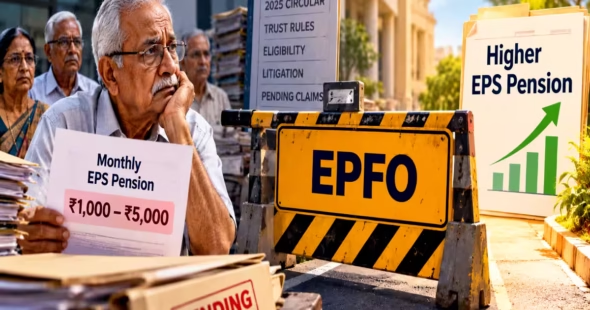
In a letter addressed to PM Modi last month, the NCPA highlighted that pending cases have left many high-ranking PSU retirees receiving only ₹1,000 to ₹5,000 monthly under the scheme.
- NCPA seeks withdrawal of the Employees’ Pension Fund Organisation circular dated January 18, 2025.
- The pensioner body demands an end to litigations and discriminatory rejections of higher pension claims.
- Appeals for waiving off delay-related interest and penalties accrued due to administrative indecision.
- Calls for establishing a time-bound redressal mechanism to clear pending higher EPS pension applications.
Discrepancies in EPFO Implementation Across PSUs
BN Agrawal, president of the NCPA and drafter of the letter, cited the example of the Steel Authority of India to point out implementation disparities. According to Agrawal, the EPFO permitted higher pensions for retirees at certain SAIL centres while denying the same at other locations.
The pensioner body also stated that applications from exempted establishments, which strictly followed government trust-related rules on wage ceilings, faced rejection. Agrawal claimed that the EPFO adopted a pick-and-choose policy, creating a class within a class.
Arguments Against the January 2025 Circular
The NCPA’s primary demand is the withdrawal of the EPFO circular dated January 18, 2025, which dictates that eligibility for higher wage pensions should rely on extant trust rules of exempted establishments in consonance with the 2022 Anil Kumar case directions.
The pensioner body argued that the executive circular forces field offices to reject Pension on Higher Wages applications if historical internal trust rules mirrored statutory wage ceilings. The letter notes that an executive body cannot use circulars to retroactively alter ground rules or dilute rights established by Supreme Court judgments.
Furthermore, the division bench of the Madras High Court on July 9, 2026, established that internal trust rules are merely administrative arrangements that cannot override parent legislation approved by Parliament under EPS-95.
Judicial Consensus and Litigation Audit
The NCPA highlighted that following the Supreme Court verdict in 2022, over 250 writ petitions and appeals are pending across 18 High Courts, with approximately 25 judgments already delivered by 10 High Courts.
The pensioner body stated that the current stance of the EPFO collides with settled law and violates the National Litigation Policy, which advises government bodies to avoid repetitive litigation. The organisation wants the government to conduct a litigation audit and withdraw frivolous appeals in higher courts where the law is settled in favour of senior citizens.
Frequently Asked Questions
Why are PSU retirees receiving low EPS pensions?
Many high-ranking PSU retirees are receiving a monthly EPS pension of only ₹1,000 to ₹5,000 because their higher EPS pension applications remain pending with the Employees’ Pension Fund Organisation.
What does the National Confederation of Pensioner Associations want from the Prime Minister?
The NCPA wants PM Narendra Modi to intervene by withdrawing the January 18, 2025, EPFO circular, stopping discriminatory litigations, waiving delay-related penalties, and establishing a time-bound redressal mechanism to clear pending higher pension applications.
Stay Updated with the Latest News and Current Affairs
Discover more from Current Affairs World
Subscribe to get the latest posts sent to your email.